
Discussions about ergonomics often bring office chairs and adjustable desks to mind. However, ergonomics encompasses the entire work environment. Two often-overlooked factors that critically impact our health and productivity are lighting and sound.
The Importance of Lighting in Ergonomics
Appropriate lighting is fundamental to an ergonomic workspace. It’s essential for minimizing eye strain; furthermore, glare and screen reflections cause visual discomfort and reduce performance.
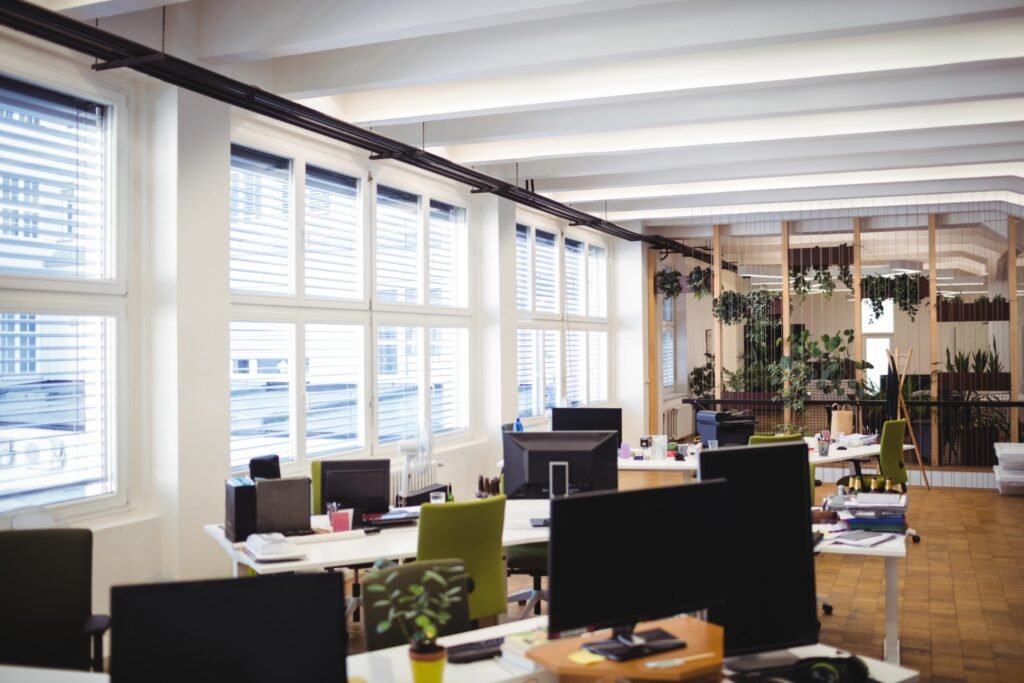
Natural versus Artificial Lighting
Research indicates that employees prefer natural light, reporting higher levels of satisfaction, well-being, and productivity. Natural light provides a full spectrum ideally suited to the human visual system.
Effects of Lighting on Health and Productivity
Studies show that appropriate lighting influences both our physiology and psychology. Certain types of light can affect hormone production, such as Cortisol, thereby regulating alertness levels and impacting overall sleep quality. Research confirms the positive effects of ergonomic lighting, which can:
- Reduce errors by up to 20%.
- Accelerate task completion.
- Increase concentration by 15%.
- Limit visual fatigue and headaches.
Lighting Colour Temperature
The colour temperature of lighting also has a significant impact:
- Cool light (): Enhances alertness and supports tasks requiring high concentration.
- Warm light (): Promotes relaxation.
The Role of Sound in Ergonomics
Noise is an often-disregarded factor, yet it significantly affects health and efficiency in the workplace.

Effects of Noise on Health
Noise triggers physiological stress responses, such as increased blood pressure and heart rate. Even common office sounds – like ringing phones, conversations, or printer noise – negatively impact the nervous and cardiovascular systems, often without conscious awareness. Extensive research links noise exposure to:
- Increased blood pressure and cardiovascular strain.
- Sleep disturbances, even when exposure occurs only during the day.
- Chronic fatigue, headaches, and irritability.
- Reduced concentration and information processing ability.
- Increased likelihood of errors and workplace accidents. Notably, employees in open-plan offices require up to 62% more sick leave days compared to colleagues in quieter environments. This highlights the serious impact noise can have on general health.
Effects of Noise on Musculoskeletal Health
Research has shown that employees in noisy environments tend to change their posture less frequently and make smaller adjustments. This lack of movement leads to remaining in uncomfortable positions for extended periods, which can cause musculoskeletal strain. When the body remains static for long durations, pressure increases on muscles, tendons, and joints, potentially leading to pain. Noise, acting as a stressor, can also induce unconscious muscle tension, further exacerbating the situation.
Interaction of Lighting and Sound
Lighting and sound interact within the work environment. An inadequately lit space can intensify annoyance from noise, while a noisy space can increase visual fatigue.
Benefits of a Holistic Approach to Ergonomics
A comprehensive approach that considers all ergonomic factors, including lighting and sound, yields multiple benefits:
- Reduction in musculoskeletal disorders.
- Improved mental health and reduced stress.
- Increased productivity.
- Fewer days of absence from work. Research confirms the negative correlation between noise and productivity, underscoring the importance of a well-designed acoustic environment.
Conclusion
Ergonomics is a holistic discipline focused on adapting the work environment to human needs. Lighting and sound play roles just as crucial as office furniture in creating a healthy and productive setting. Proper lighting and suitable acoustics in a workspace reduce visual and musculoskeletal strain, improve mood, and boost productivity. Recognizing the importance of holistic ergonomics benefits both employees and organizations.
Blog written by Michail Arvanitidis
References
- Akbari J, Dehghan H, Azmoon H, Forouharmajd F. Relationship between lighting and noise levels and productivity of the occupants in automotive assembly industry. J Environ Public Health. 2013;2013:527078. doi:10.1155/2013/527078
- European Agency for Safety and Health at Work. Work-related musculoskeletal disorders: Prevalence, costs and demographics in the EU. Publications Office of the European Union; 2019.
- Katabaro JM, Yan Y. Effects of Lighting Quality on Working Efficiency of Workers in Office Building in Tanzania. J Environ Public Health. 2019;2019:3476490. doi:10.1155/2019/3476490
- Khajenasiri F, Zamanian A, Zamanian Z. The Effect of Exposure to High Noise Levels on the Performance and Rate of Error in Manual Activities. Electron Physician. 2016;8(3):2088-2093. doi:10.19082/2088
- Králiková R, Wessely E, Sokolová H. Lighting Quality and its Effects on Productivity and Human Health. Research Papers Faculty of Materials Science and Technology Slovak University of Technology. 2016;24(38):25-31. doi:10.1515/rput-2016-0008
- Passchier-Vermeer W, Passchier WF. Noise exposure and public health. Environ Health Perspect. 2000;108(Suppl 1):123-131. doi:10.1289/ehp.00108s1123
- Pejtersen JH, Feveile H, Christensen KB, Burr H. Sickness absence associated with shared and open-plan offices–a national cross sectional questionnaire survey. Scand J Work Environ Health. 2011;37(5):376-382.
- Rasouli Kahaki Z, Jahangiri H, Smith AP, Kazemi R. Subjective and objective survey of office lighting: effects on alertness, comfort, satisfaction, and safety. Med Lav. 2022;113(3):e2022024. doi:10.23749/mdl.v113i3.12371
- Viola AU, James LM, Schlangen LJ, Dijk DJ. Blue-enriched white light in the workplace improves self-reported alertness, performance and sleep quality. Scand J Work Environ Health. 2008;34(4):297-306. doi:10.5271/sjweh.1268